Treatments for Temple Hollows in Seoul, Korea
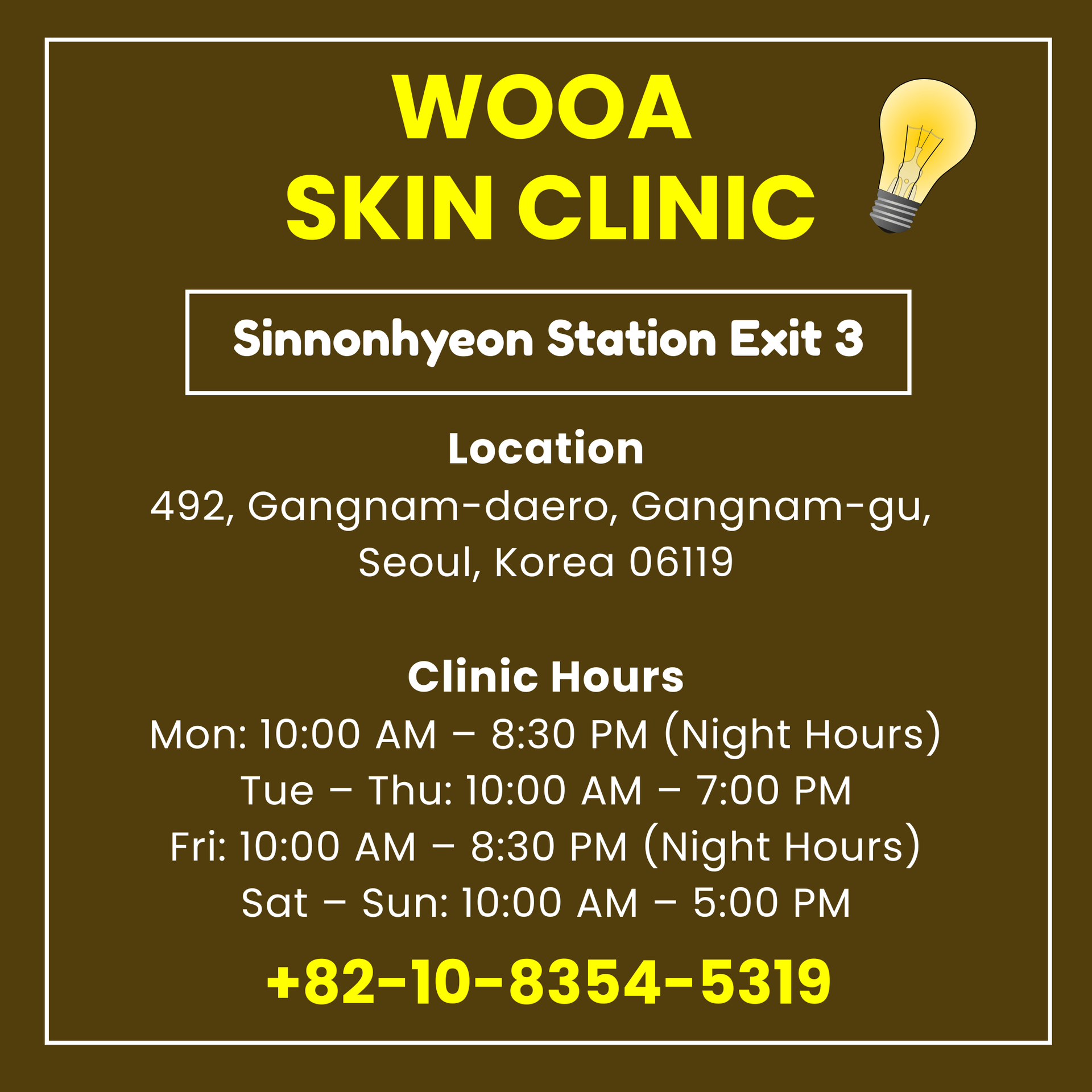
Gangnam WOOA Skin Clinic
Sinnonhyeon Exit 3
Treatments for temple hollows focus on restoring age-related or naturally occurring volume loss around the sides of the forehead to create smoother, more balanced facial contours. Gangnam WOOA Skin Clinic in Seoul provides personalized temple rejuvenation for international patients, with treatment options selected according to facial anatomy, degree of hollowing, skin quality, and overall facial proportions.
What Are Temple Hollows?
Temple hollows are depressions or sunken areas between the forehead, eyebrows, hairline, and cheekbones.
They can create:
- Sunken-looking temples
- A more skeletal facial appearance
- Uneven upper-face contours
- Reduced facial softness
- More prominent cheekbones
- An aged or tired appearance
- Imbalance between the forehead and cheeks
Some people naturally have hollow temples, while others develop them gradually with age.
What Causes Hollow Temples?
Temple hollowing may be associated with:
- Age-related facial volume loss
- Natural facial anatomy
- Genetics
- Changes in facial fat
- Changes in underlying bone structure
- Significant weight loss
- Reduced soft-tissue support
The best treatment depends on the degree of hollowing and how the temples relate to the rest of the face.
Best Treatments for Temple Hollows
Depending on anatomy and treatment goals, options may include:
Temple Filler – for targeted volume restoration
Collagen-Stimulating Treatments – for selected facial volume and skin-quality concerns
Skin Boosters – for surrounding skin hydration and quality
Combination Facial Rejuvenation – when temple hollowing occurs with cheek or midface volume loss
Treatment should focus on facial harmony rather than simply filling the deepest area.
Temple Filler for Hollow Temples
Dermal filler may be considered for suitable patients with temporal volume loss.
Carefully planned treatment may help:
- Soften temple depressions
- Create smoother upper-face contours
- Reduce a skeletal appearance
- Improve forehead-to-cheek transition
- Restore more balanced facial proportions
The goal is subtle volume restoration without making the temples appear excessively full.
Temple Hollows and Facial Aging
Temple hollowing can become increasingly visible with age as facial volume distribution changes.
It may occur alongside:
- Cheek volume loss
- Under-eye hollowing
- Skin laxity
- Brow changes
- Facial thinning
- Deeper wrinkles
For this reason, the temples should be assessed as part of the entire face rather than as an isolated area.
Temple Hollows and Cheek Volume Loss
Hollow temples and flatter cheeks may occur together.
Treating only the temples may not always create the most balanced rejuvenation when significant volume loss is also present elsewhere.
Selected patients may benefit from a broader facial volume assessment before treatment.
Temple Filler for a More Balanced Face Shape
Temple volume influences the contour between the forehead and cheekbones.
Restoring selected volume may create a smoother facial outline and reduce excessive indentation at the sides of the upper face.
The appropriate amount depends on existing bone structure, facial width, and surrounding volume.
Natural-Looking Temple Rejuvenation
Temple treatment should generally be conservative.
Excessive correction can change facial proportions and make the upper face appear unnaturally wide or full.
Treatment should aim to soften hollowing while preserving the patient's natural facial structure.
Is Temple Filler Different From Cheek Filler?
Yes.
Temple filler primarily addresses volume deficiency in the temporal region, while cheek filler focuses on the cheek or midface.
Some patients may need only one area treated, while others may benefit from carefully coordinated volume restoration.
Are Temple Hollows Always Caused by Aging?
No.
Some younger patients naturally have more prominent temple hollows because of genetics, bone structure, or facial fat distribution.
Treatment should therefore be based on individual anatomy rather than age alone.
Safety and Temple Filler
The temple is an anatomically complex area containing important blood vessels and deeper structures.
Filler treatment in this region requires careful anatomical assessment, appropriate product selection, and precise injection technique.
Patients should discuss potential benefits, limitations, and risks during consultation before treatment.
Combination Treatment for Facial Volume Loss
When temple hollowing occurs with broader facial aging, a personalized plan may consider:
Temple Filler for temporal volume
Cheek or Midface Filler for selected facial support
Skin Boosters for skin quality
RF or HIFU for accompanying laxity
Botox for selected expression wrinkles
Not every patient requires multiple treatments.
Korean Temple Hollow Treatment for International Patients
Seoul is a popular destination for international patients seeking Korean temple filler, facial volume restoration, and non-surgical facial rejuvenation.
Gangnam WOOA Skin Clinic near Sinnonhyeon Exit 3 provides personalized treatment planning according to temple anatomy, facial proportions, volume distribution, skin quality, and individual aesthetic goals.
Frequently Asked Questions
What is the best treatment for hollow temples?
Dermal filler is one option for selected patients with temple volume loss. The appropriate treatment depends on facial anatomy and degree of hollowing.
Can filler fix hollow temples?
Filler may help restore selected temple volume and create a smoother transition between the forehead and cheekbones.
Do hollow temples make you look older?
Temple volume loss can contribute to a more skeletal or aged appearance, particularly when combined with cheek and under-eye volume changes.
Can younger people have temple hollows?
Yes. Temple hollowing may be related to natural anatomy, genetics, or facial fat distribution and is not exclusively an age-related concern.
How much temple filler do I need?
The amount varies according to the degree of hollowing, facial anatomy, treatment goals, and the filler selected.
Can temple and cheek filler be combined?
Yes. Selected patients with volume loss in both areas may benefit from coordinated treatment to maintain balanced facial proportions.
Where can foreigners get temple hollow treatment in Gangnam?
International patients can visit Gangnam WOOA Skin Clinic near Sinnonhyeon Exit 3 for personalized temple volume restoration and facial rejuvenation treatments.
Restore Smoother, Balanced Temple Contours
Treatment for temple hollows should focus on restoring appropriate temporal volume, smoothing upper-face contours, and maintaining harmony between the forehead, temples, and cheeks.
Gangnam WOOA Skin Clinic provides personalized temple hollow treatments for international patients seeking subtle, balanced, and natural-looking facial rejuvenation in Seoul.